
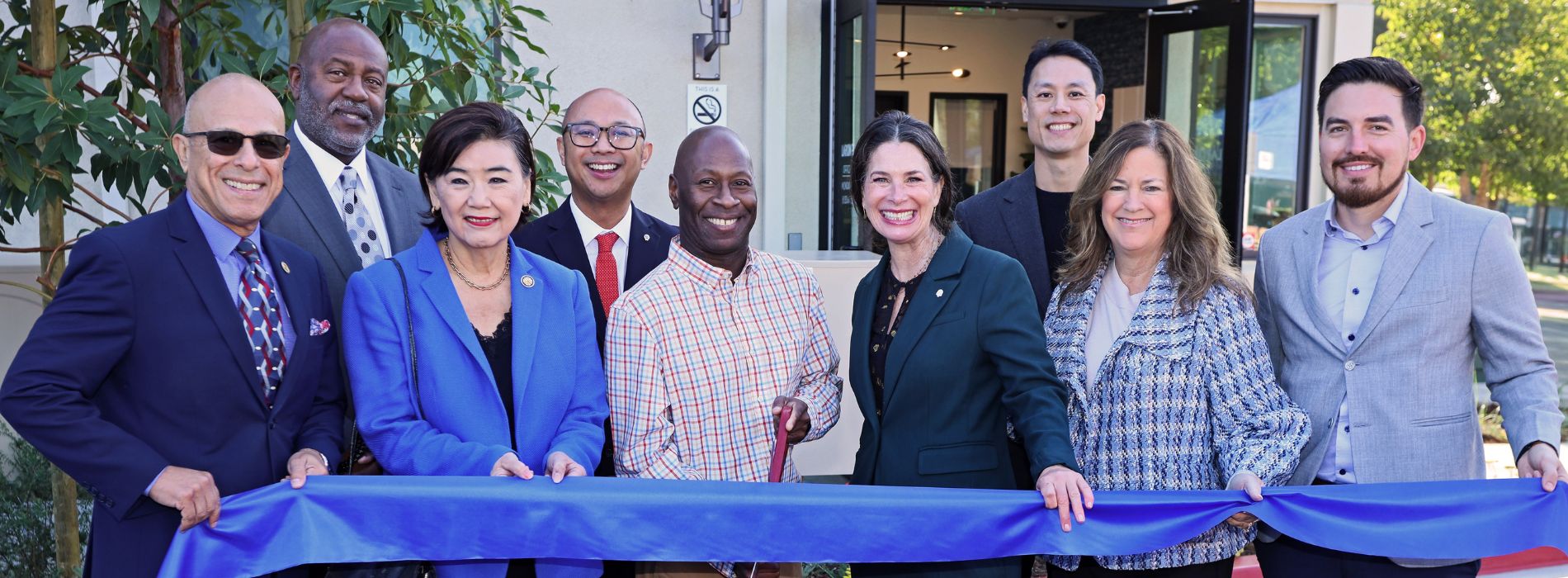
On March 11, 2026, community partners, local leaders, service providers and residents gathered to celebrate the grand opening of Larkin Place, a new 32-unit permanent supportive housing community located at 731 Harrison Avenue in Claremont.
Developed by Jamboree Housing Corporation, Larkin Place brings this evidence-based model to Claremont. What was once an underutilized site previously owned by Pilgrim Place has now been transformed into a vibrant, service-rich community designed to support residents on their path toward stability, wellness, and long term recovery.
All 32 units, including 8 studios and 24 one-bedroom apartments, are reserved for individuals earning up to 30 percent of the Area Median Income (AMI), with Project-Based Vouchers ensuring residents pay no more than 30 percent of their income toward rent. The application process is comprehensive and often months long, requiring individuals to navigate the county’s coordinated entry system and gather documentation to verify eligibility, ensuring that those with the highest needs are prioritized for housing and supportive services.
At the grand opening, Jed Leano, Chair of the San Gabriel Valley Regional Housing Trust, Claremont City Councilmember, and Chair of Tri-City Mental Health Authority’s Governing Board, reflected on the transformation of the site and the lives it will impact.
“We are standing upon what was once a vacant lot but, today, we stand on the foundation of hope. This four-story community is not just a building. We are celebrating the opening of 32 doors, 32 new beginnings for our neighbors, and those who have navigated the hardships of being unhoused. This project proves that when we look at underutilized land, we should see the potential for life-changing miracles.”
A Regional Commitment to Housing Solutions
The development of Larkin Place reflects a strong federal and regional commitment to expanding affordable housing options. Congresswoman Judy Chu secured $3 million in federal funding for the project through the San Gabriel Valley Regional Housing Trust. Since Fiscal Year 2022, Congresswoman Chu has helped deliver $8.25 million in Community Project Funding to support housing initiatives across the San Gabriel Valley.
“Increasing our region’s affordable housing supply is one of my top priorities in Congress,” said Congresswoman Chu. “That’s why I was proud to secure $3 million in federal funding for Larkin Place, which will provide 32 units of permanent supportive housing to help ensure members of our community have the stability and services needed to rebuild their lives.”
Permanent Supportive Housing: A Proven Public Health Strategy
Homelessness is not only a housing issue, it’s a profound public health challenge. Individuals experiencing homelessness are significantly more likely to live with serious mental health conditions, chronic medical conditions, and substance use disorders. The instability of homelessness often leads to long gaps in care, frequent emergency room visits, and repeated hospitalizations.
Permanent supportive housing directly addresses these challenges by pairing stable housing with onsite services. Research shows this model works. A RAND Corporation study of Los Angeles County’s Housing for Health program found that supportive housing with case management led to dramatic reductions in health care use. Public service costs for participants dropped by nearly 60 percent in the first year, and residents reported improved mental health after being housed.
Larkin Place builds on this evidence, offering residents the stability and support needed to improve their health, reconnect with community, and pursue long-term goals.
A Full Spectrum of Onsite Support
Residents at Larkin Place have access to comprehensive wraparound services delivered in a trauma-informed, harm-reduction environment. Jamboree’s Community Impact team and Tri-City Mental Health Authority (TCMHA) work together to provide case management, peer support and group activities, individual and group therapy, crisis counseling, recovery services, life skills education, including budgeting, employment readiness, and conflict resolution, as well as community-building activities that foster connection and belonging.
Jed Leano also highlighted the essential role of TCMHA in ensuring residents receive the support they need to build their lives.
“Through our partnership with Tri-City Mental Health Authority, residents will not walk this path alone. Having trained professionals right here to provide case management and community-building activities ensures that every person who lives here has the support they need to truly thrive. We are telling them, ‘you are seen, you are valued and you are home.’”
By embedding behavioral health professionals directly within the housing community, residents receive the support they need to heal, recover and grow, right where they live. Ontson Placide, Executive Director of Tri-City Mental Health Authority, described the organization’s role in ensuring residents not only obtain housing, but are supported in maintaining it.
“Our role in this housing development, and others like this, is ensuring residents do not simply obtain housing, but they have the clinical, social and practical support necessary to remain housed and thrive over time. Many individuals who qualify for permanent supportive housing have experienced long periods of instability, often connected to untreated mental health conditions, trauma or other barriers to stability. Housing provides the foundation, and essential supportive services provide a pathway forward.”
Placide emphasized that TCMHA's approach is individualized, voluntary, and rooted in trust.
“Our Housing team works alongside residents to identify what each individual needs to be successful: that may include mental health care, case management, connection to primary medical services, assistance navigating benefits, employment support, or help rebuilding social networks and building daily living skills. Residents are not required to follow a one-size-fits-all program. Rather, we meet people where they are, focusing on engagement, trust and practical problem-solving.”
For many residents, Larkin Place represents more than a roof over their heads, it’s a turning point to healing, recovery and stability.
“Having a safe place to live has changed my life in ways that are hard to put into words,” said Jerry Dixon, a Larkin Place resident. “When you have stability again, you can start thinking about the future.”
Larkin Place stands as a powerful example of what becomes possible when housing, mental health care, and community partnership come together. Housing becomes more than a building, serving as a foundation for healing, stability, and new beginnings for 32 individuals who now have a place to call home.